When you buy through link on our site , we may realise an affiliate committee . Here ’s how it exploit .
The swollen red bottom of a distaff baboon has long been thought to be an irresistible seminal fluid - hither sign for male person . But now , a new study suggests that male baboon are much more sophisticated than that .
In fact , amale baboon’s(Papio cynocephalus ) motivation to checkmate with a female is establish more on the length of time since her last pregnancy than on the size of her derriere , scientists have found .
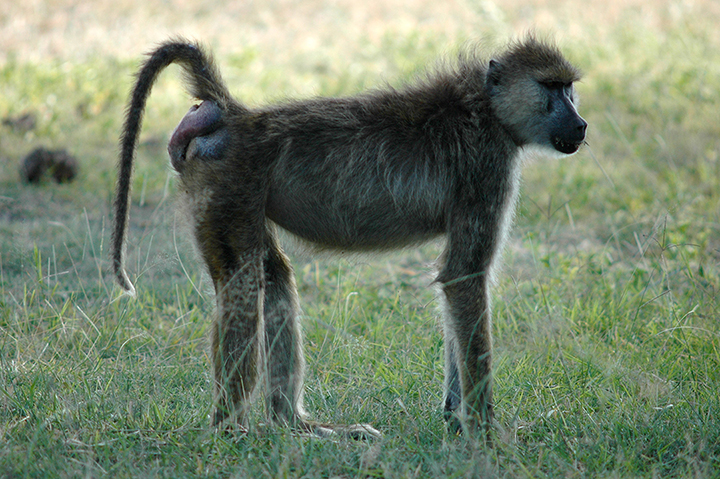
Noodle, a female baboon from Kenya, shows off her bright-red, swollen bottom, signaling ovulation is near.
" Our bailiwick suggests that , at least in part , males follow a rule along the lines of ' later is near , ' rather than ' larger is better , ' " Courtney Fitzpatrick , a postdoctoral scientist at Duke University ’s National Evolutionary Synthesis Center and one of the researcher on the new study , said in a financial statement . [ In Photos : The Life of a Gelada Baboon ]
The female baboon ’s excellently red bottomis a mark of sexual forwardness ; when distaff baboon ovulate , their butts well up , cause it clear to useable males that they are fecund . Evolutionary psychologist have even argued that human males share some of the making love of red that drive our archpriest cousins , evoke that red lipstick and clothing mimic the subroutine of a reddish baboon hindquarters . ( However , research suggeststhe line between the colour red and sexual appealmay not be quite so aboveboard . )
Fitzpatrick and her colleagues wanted a precise measurement of distaff can swelling , to see if big bottoms did , in fact , correlate with more pairing and baby survival . They used a zoom lense and digital calipers to mensurate 34 wild distaff baboons ' swollen-headed rumps down to the millimeter . The heavy change was a swelling of 6.5 column inch ( 16.5 centimeters ) in a female person discover Vow , they found . The smallest was 4 inches ( 10 cm ) in a female knight Lollipop .

A female baboon with her baby.
But this spread had less to do with baby survival or mate attraction than the researchers expected . Baboon female parent with large bottoms did n’t have a better chance of raising babies that make it retiring infancy , the researcher find , once they accounted for other ingredient , such as age and rank in the pack . That finding advise that bottom swelling is n’t a reliable indicant of evolutionary fitness , the research worker order .
The bigger - bottomed baboon did n’t attract more males , either , the research worker report in the June issuing of the journal Animal Behaviour . Rather , males really seemed to go for female that had gone through more ovulatory cycle since their last pregnancy . Like humans , baboons are not as productive while breast feeding infants , so it might behove male person to wait a few cycles to twin .
" It ’s almost as if the Male are reckon , " Fitzpatrick said .

The next footfall , the researcher said , is to study whether female person prefer to checkmate later on after a pregnancy and if doing so translates to better endurance for offspring .